
What can we learn from exceptional ovarian cancer survivors?
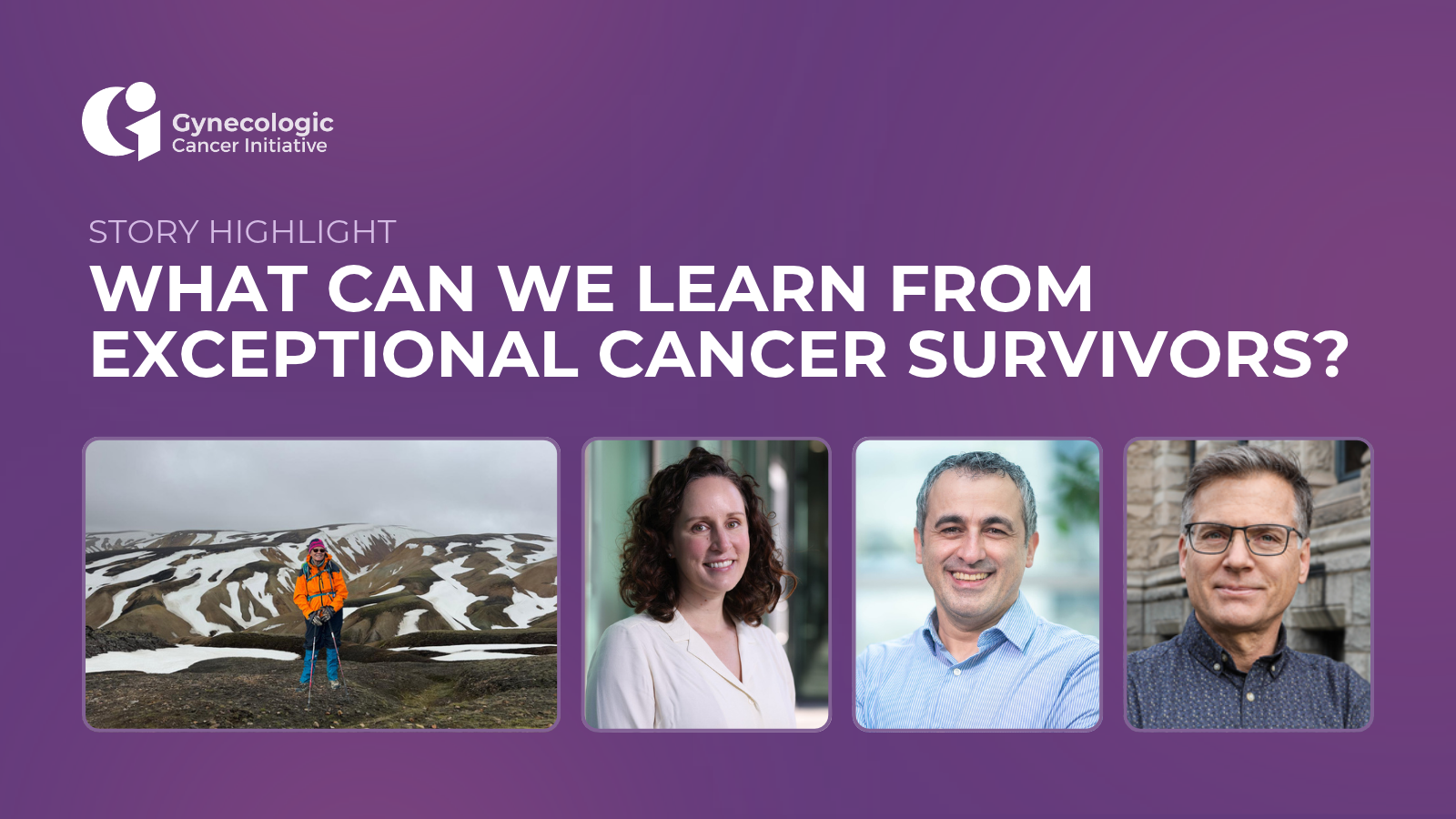
UBC’s Faculty of Medicine recently sat down with GCI Members Dr. Ali Bashashati, Dr. Brad Nelson, and Dr. Gillian Hanley to discuss the international Multidisciplinary Ovarian Cancer Outcomes Group (MOCOG) study. Joining the conversation, GCI Patient and Family Advisory Council Member Penelope Hedges shares her lived experience with ovarian cancer and reflects on the importance of patient perspectives in research.
Story courtesy of the University of British Columbia’s Faculty of Medicine. Read the original story here.

What can we learn from cancer super survivors?
UBC researchers are helping to lead a major international research project exploring why some ovarian cancer patients beat the odds.
Penelope Hedges isn’t quite sure why she’s still here. An energetic retiree who looks a decade younger than her 71 years, she’s the first to admit that, statistically speaking, she’s a bit of an outlier.
In 2012, at the age of 57, Hedges was diagnosed with an aggressive form of ovarian cancer. “At the time, I just thought, ‘Ovarian cancer. You die from that,’” she recalls.
Surgery and chemotherapy put the cancer in remission — for a time. In 2018, it returned. Hedges, a patient partner with the Gynecologic Cancer Initiative (GCI), led by UBC researchers, entered active treatment once again. And the cancer hasn’t resurfaced since.
“Is it something I’m doing that is helping me stay cancer-free? Or is it something that I’m not doing? Let’s try and find out as much as we can.”
— Penelope Hedges
“I’m very active — I hike, I walk, I cycle, I don’t smoke. I drink one to two drinks a week. I go about my life. I think I’m very ordinary,” she says.
Hedges is far from ordinary. High-grade serous carcinoma (HGSC), the most common type of ovarian cancer, has a median overall survival of about three years, with fewer than 50 per cent of patients surviving past five years and only 15 per cent surviving past 10.
“I’ve met a few other women with it, and they have all died or are about to die. Why am I still here with no more recurrences? I don’t know,” she says.
Why some patients, like Hedges, survive so much longer than others is one of ovarian cancer’s biggest mysteries. Is it their lifestyle? Their genetic makeup? Their immune systems? These are questions that UBC researchers are working hard to figure out as part of a major international study, the Multidisciplinary Ovarian Cancer Outcomes Group (MOCOG).
Made up of investigators and patient advocates from Canada, Australia, the U.K. and U.S., MOCOG has a database of more than 1,200 patient profiles and tumour samples, divided into three groups: long-term survivors of over 10 years, intermediate survivors of five to eight years and short-term survivors of less than five years.
“The idea is that by comparing them, we can figure out why some patients live so much longer, and ultimately uncover new treatments and protocols for patients,” explains Dr. Brad Nelson, professor of medical genetics at UBC and distinguished scientist at BC Cancer.
The immunity factor
Dr. Nelson joined the project in 2016 to lead its immunology arm, which is studying how the body’s immune system recognizes and attacks ovarian cancer — and what sort of defence packs the biggest punch.
After years of painstakingly analyzing thousands of tumour samples, he’s made intriguing findings from the MOCOG data, piecing together how the immune system deploys its invader-killing T cells and antibody-producing B cells to mount an attack against the tumour.
“With such a large number of samples, we were able to confirm that the most powerful predictor of long-term survival was having both T cells and B cells present in the tumour. In a really strong response, the immune cells almost outnumber the tumour cells,” he says.
The killer T cells poke holes in the cancerous cells and inject them with toxic compounds that kill them within minutes, while the B cells release antibodies that tag the cancerous cells for destruction, he explains.
“Patients always ask what they can do to have a strong immune response, and by finding these links, we’ll be able to give them real hope.”
— Dr. Brad Nelson

“We’re now asking, ‘How are these two immune cell types working together to do this job? And why do some patients have this stronger immune response? Is it because they’re taking other medications or something in their diet?’ Those are the sorts of links that we’re hoping to be able to make,” he says.
“Patients always ask what they can do to have a strong immune response, and by finding these links, we’ll be able to give them real hope.”
Survivor lifestyles
This is where the work of Dr. Gillian Hanley, an associate professor of obstetrics and gynaecology at UBC and director of the Women’s Health Research Institute, comes in. A member of MOCOG’s epidemiology team, she’s analyzing patient data to find clues about how environmental exposures — diet, medication, exercise — are correlated with longer-term survival. And she’s uncovering some interesting patterns that could help inform guidelines and treatment programs for patients.
“Statins [cholesterol-lowering medications] showed a clear and clean correlation with better outcomes,” she reports. “Individuals who were either on a statin at the time of their ovarian cancer diagnosis or started a statin after their ovarian cancer diagnosis had improved survival.”
Perhaps most surprising was the effect of a particular steeped beverage. “People who consumed the most amount of green tea appeared to have significantly improved survival. That was not true for other forms of tea, and it was not true for coffee or other drinks” she says. “So, statins and green tea are two things that we’re trying to now take forward into clinical trials.”

Whether it’s brewing matcha or repurposing cholesterol drugs to boost immunity, the secret to super survival is unlikely to come down to one magic ingredient.
But could there be a magic formula?
From AI to answers
“We know cancer is a complex system, with genetics, the immune system and lifestyle all interacting. Recent advances in AI are now letting us connect the dots across these massive datasets to uncover patterns that would be nearly impossible for people to find on their own,” says Dr. Ali Bashashati, associate professor in the School of Biomedical Engineering and Pathology and Laboratory Medicine. He joined the MOCOG group this year to lead its AI work, after being awarded $2 million in international funding.
Dr. Bashashati will train AI models on the reams of data collected by MOCOG researchers over the past decade, and compare its predictions with actual patient outcomes. When the AI starts reaching a degree of accuracy, Dr. Bashashati will piece out what indicators it’s drawing on to make these accurate predictions.
“We don’t just want to build an AI model; we want to understand patient biology and identify biomarkers for better survival,” he says. “As we discover more, we’ll be able to develop better drugs and treatments.”


For Hedges, who still lives with the threat of a recurrence hanging over her, understanding exactly why she’s survived for so long would bring clarity and peace of mind, as well as a pathway to continued health. It would also offer hope to the 3,000 Canadian women diagnosed with ovarian cancer each year.
“When I was first diagnosed, what did we know about ovarian cancer? Nothing except you die quickly,” she reflects. “Is it something I’m doing that is helping me stay cancer-free? Or is it something that I’m not doing? Let’s try and find out as much as we can.”
Stay in the loop with the Gynecologic Cancer Initiative: