
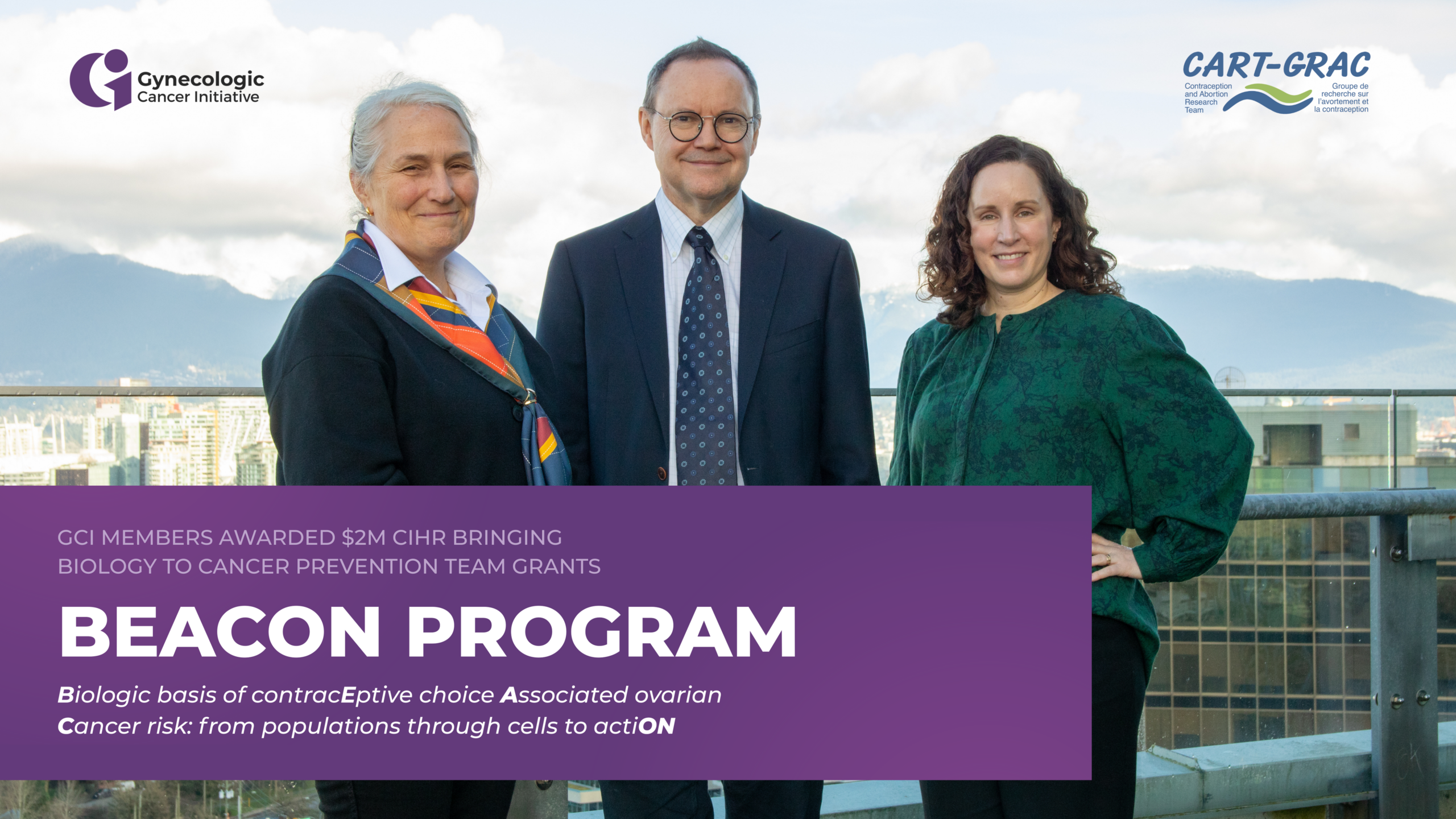
BEACON Program awarded funding to integrate cancer prevention into precision contraception
The BEACON program (Biologic basis of contracEptive choice Associated ovarian Cancer risk: from populations through cells to actiON), led by GCI Members Drs. David Huntsman, Gillian Hanley, and Wendy Norman, has been awarded $2M from CIHR’s Bringing Biology to Cancer Prevention Team Grants to integrate cancer prevention into precision contraception.
High-grade serous cancer (HGSC) is the most common and deadliest form of ovarian cancer. As there is no effective way to screen for it, finding ways to prevent it is especially important. Birth control pills (combined oral contraceptives or COCs) cut the risk of HGSC in half when used for five or more years. This protective effect has been known for decades, but we still do not fully understand why it happens. At the same time, contraceptive use is rapidly shifting: fewer people are using COCs, and more are choosing hormonal intra-uterine devices (IUDs). Early research suggests that hormonal IUDs may not provide the same protection against this type of ovarian cancer, raising real concerns about a possible rise in cases of a cancer that is often deadly and hard to treat. This makes it especially important for individuals to have clear, evidence-based information when making decisions about birth control.
The team will study how COCs, IUDs, and newer estrogen-free pills (like drospirenone) influence cell growth, DNA damage, and inflammation. At the same time, we will use large-scale population data to model how changing contraceptive trends may affect ovarian cancer rates in the future. By uncovering how certain contraceptives may help prevent ovarian cancer, and working with end knowledge users and national partners like the Society of Obstetricians and Gynecologists of Canada, Action Canada for Sexual Health and Rights, BC Women’s Hospital and Health Centre, Canadian Cancer Society, Ovarian Cancer Canada and Society of Gynecologic Oncology of Canada, BEACON aims to support the development of tools and information that can shape future contraception options that also reduce cancer risk.
BEACON brings together a diverse team of Canada’s unparalleled leaders in cancer biology, cancer prevention, reproductive epidemiology, contraceptive research, clinical care, and knowledge mobilization, forming a synergistic, impact-driven interdisciplinary team. To date, progress in cancer prevention and contraceptive care has largely occurred in parallel. BEACON bridges these fields for the first time, leveraging complementary expertise across all four CIHR Pillars (PI-IV), driven by both emerging and established leaders working in close partnership with Knowledge Users. Importantly, BEACON will establish an innovative, adaptable framework that can expand precision contraception approaches to prevent other cancers influenced by contraceptive choices, including endometrial, colorectal and breast cancers. Tune in to the GOSH podcast, where the Principal Investigators share their vision and the anticipated impact of the BEACON program.
Stay in the loop with the Gynecologic Cancer Initiative: